Dead Codes Everywhere: What Six Weeks of Testing 200 Vouchers Taught Us About the UK's Discount Sites
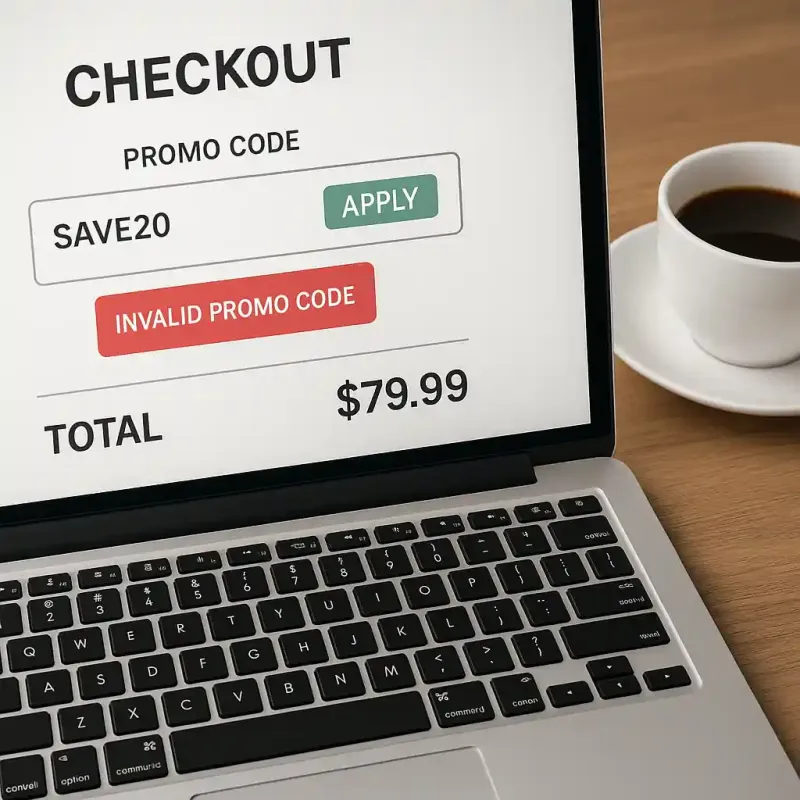
Photo: laptop checkout online shopping discount code box, via premiumpromocodes.com
Every UK shopper knows the ritual. You're at the checkout, a box politely asks if you have a promo code, and a little voice says: check the voucher sites first. So you open a new tab, search the brand, and copy a code promising 20% off that claims to have been 'verified four minutes ago'.
We wanted to know how often that ritual actually pays off. So for six weeks, we ran a proper audit: 200 discount codes pulled from the UK's biggest voucher websites, tested one by one against real baskets at fashion retailers, takeaway apps and homeware stores. We logged every success, every failure and every cryptic error message.
The headline figure isn't pretty. Of 200 codes, just 61 worked as advertised — a strike rate of roughly 31%. The rest were dead on arrival.
Where All the Dead Codes Go
The failures fell into a few familiar buckets. Around 40% simply didn't exist anymore — expired weeks or months earlier, yet still sitting on the sites labelled 'working' or, our personal favourite, 'verified today'. Another chunk were technically valid but rejected at checkout for reasons the voucher sites never mention: new customers only, app orders only, full-price items only, or 'selected lines', which turned out to mean roughly four clearance lampshades.
Takeaway codes were the worst offenders. Fast food promotions are often regional, time-limited or capped at a handful of redemptions, yet aggregator pages presented them as evergreen offers. Fashion codes failed mostly on exclusions — sale items, designer collabs and that one perennially excluded denim brand.
Follow the Money (Again)
Here's the bit that surprised us most, and it explains a lot: voucher sites don't need codes to work to get paid. Most operate on affiliate deals with retailers. When you click through from a voucher site and buy anything — valid code or not — the site often pockets a commission on your basket.
Read that back. A voucher site can list an expired code, you click through, your code fails, you buy anyway because you've already filled your basket, and the site earns its cut. There is, economically speaking, very little incentive to prune the graveyard.
Some sites do better than others. The ones we rated highest updated frequently, flagged exclusions up front, and let users report dead codes publicly. The worst hid user comments, buried expiry dates, and stacked '50% off!' claims that dissolved into 5% off full-price items you didn't want.
Our Rankings, Honestly Earned
After 200 checkouts, a rough hierarchy emerged. The big generalist aggregators were fine for the big generalist retailers — high street fashion, big takeaway chains, electronics — where affiliate deals are thick on the ground and codes get refreshed often. Niche sites covering, say, homeware or garden centres were patchier but occasionally surfaced genuine exclusives the giants missed.
The most reliable source of working codes, though? The retailer's own app or newsletter. Sign-up discounts, birthday vouchers and app-only offers beat the aggregators more often than not. It costs you an email address, but unlike a dead code, it reliably lands.
Why Retailers Quietly Strangle Their Own Discounts
Retailers aren't innocent bystanders here. A code that applies to everything is a code that cannibalises full-price sales. So brands build in the fine print: exclusions on new season stock, minimum spends, one use per customer, stacking bans. Some even run 'public' codes they expect to fail, purely to capture the affiliate traffic and the basket-completion behaviour that comes with it.
The practical takeaway for savvy shoppers is a short checklist. Always check whether the code has user-reported success dates, not just a 'verified' badge. Read the exclusions before you fill your basket, not after. Try the code in a fresh incognito window so a stored basket doesn't muddy the result. And if a code fails twice, walk away — the checkout box is designed to make you feel like you're losing money by not using it. You're not. The price was always the price.
The Verdict
Voucher sites aren't a scam, exactly. They're a business whose incentives point gently away from you. Used with a sceptic's eye — recent user confirmations, clear exclusions, a healthy distrust of ALL-CAPS promises — they'll occasionally save you a tenner on a takeaway or a winter coat.
Just don't mistake 'verified four minutes ago' for the truth. In our six weeks of testing, that badge was right about as often as a coin toss. You deserve better odds than that.